
how-to
How long does caviar last in fridge once opened? | Caviar Kitchen
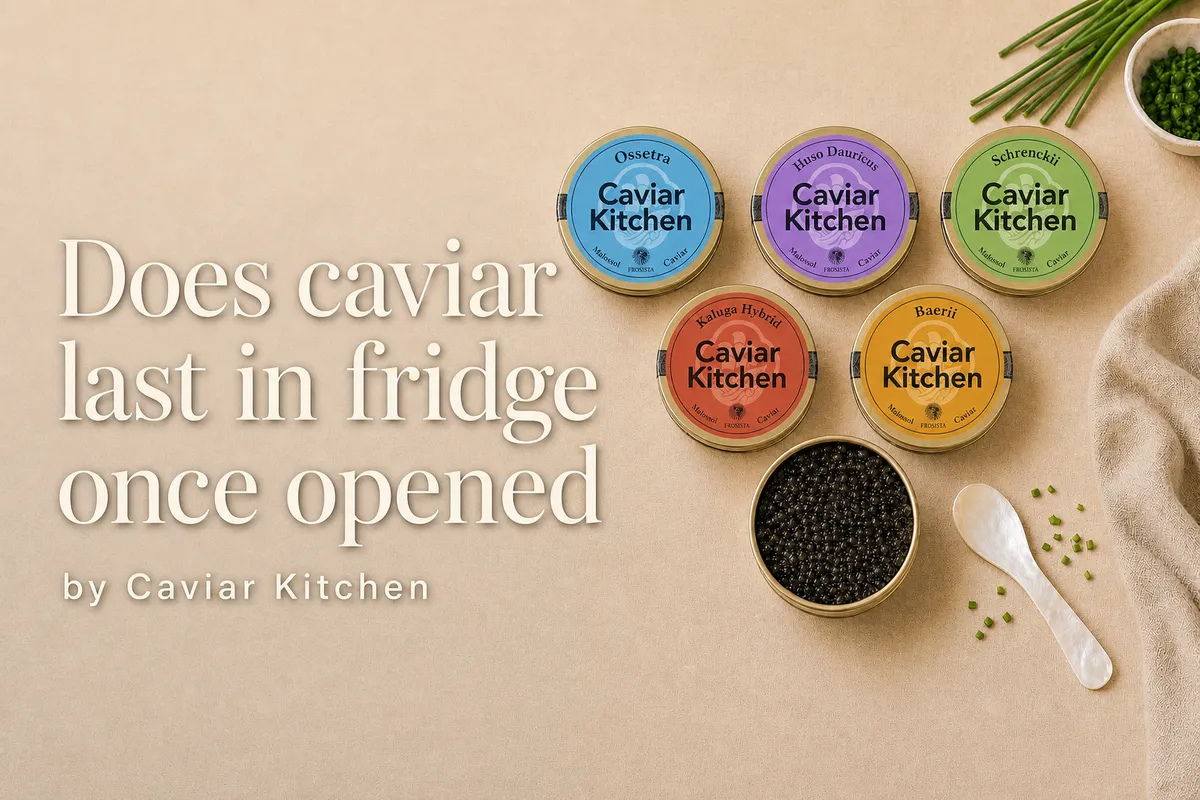
How long does caviar last in fridge once opened?
Opened caviar lasts 24 to 48 hours in the fridge, primarily because the salt-cured roe begins oxidising the moment the tin's vacuum seal breaks. Pasteurised caviar is the exception — it holds for 3 to 5 days once opened, thanks to a mild heat treatment that slows microbial activity without cooking the eggs. Either way, the clock starts the second you pop the lid.
Why does opened caviar go off so quickly?
Fresh sturgeon roe is minimally processed — just roe, salt, and sometimes a touch of borax substitute. That simplicity is why it tastes clean and bright straight from the tin. It is also why oxidation moves fast once air gets in: the fat-rich eggs are exposed, the salt equilibrium shifts, and the delicate membrane around each grain starts to break down. Within 48 hours, that breakdown shows up as a flatter, fishier, slightly mushy product — still safe to eat in most cases, but noticeably worse.
- Oxidation flattens flavour within hours of opening
- Temperature fluctuation accelerates breakdown — keep it at or below 2 °C
- Air exposure is the main enemy; press cling film directly onto the surface
- Contamination from metal spoons speeds spoilage — use mother-of-pearl or plastic
Pasteurised caviar has already been gently heat-treated, which neutralises more of the bacteria present at packing. That extra margin is why it survives 3 to 5 days post-opening rather than 2. The trade-off is a slightly firmer grain and a subtler flavour peak — something worth knowing before you choose a tin. Our full caviar guide walks through the difference between fresh and pasteurised in more detail.
How long does caviar stay fresh once opened — by type?
Not all caviar behaves identically after opening. The 3 variables that matter most are processing method, salt content, and grain size. Lightly salted fresh caviar (malossol, meaning roughly 3–5% salt) is the most perishable. Higher-salt pressed caviar — a rarer style — can stretch a day or two further. Here is how the main types compare:
| Type | Processing | Opened shelf life (fridge) | Best for |
|---|---|---|---|
| Fresh malossol | Salt only, ~3–5% | 24–48 hours | Tasting the grain at its best |
| Pasteurised | Heat-treated + salt | 3–5 days | Smaller portions over several sittings |
| Pressed (payusnaya) | Higher salt, compressed | Up to 7 days | Cooking applications, spreading |
| Salmon roe (ikura) | Brine-cured | 3–5 days | Sushi, rice bowls — not true sturgeon caviar |
The Kaluga Hybrid and Ossetra tins we carry are fresh malossol — so the 24-to-48-hour window applies. If you are buying for a dinner party and want flexibility across two nights, that is worth planning around. A 30 g tin is a single sitting for 2 people; a 50 g tin can stretch across an evening if you reseal it properly between courses. Check our how-to-eat-caviar page for portion guidance that makes the maths easier.
What is the best way to store caviar to keep it fresh?
The coldest, most stable spot in your fridge is the back of the bottom shelf or a dedicated deli drawer — not the door, which swings between 4 °C and 10 °C every time you open it. Caviar wants to sit at 0 to 2 °C consistently. A few practical steps make a real difference:
- Reseal the tin immediately after each use — do not leave it open on the counter
- Press cling film directly onto the surface of the roe before closing the lid
- Nest the tin in crushed ice inside a bowl if your fridge runs warm
- Never use a metal spoon to scoop from the tin — metal accelerates oxidation and leaves a metallic taste
- Keep it away from strong-smelling foods — roe absorbs odours through the membrane
- Do not freeze fresh malossol caviar — the grain structure collapses on thawing (more on this below)
We often hear from customers who stored a half-finished tin on the fridge door and were disappointed 24 hours later. Moving it to the back of the bottom shelf, sealed with cling film, consistently gives a better result. For more on handling once the tin is open, our guide to eating caviar covers spoon choice, serving temperature, and the 15-minute rule for letting the tin come up slightly before serving.
Signs your opened caviar has turned
Trust your senses. Fresh caviar smells clean — briny, faintly oceanic, not aggressively fishy. Texture should be firm: each grain holds its shape and pops cleanly. Here is what to look for when something is off:
- Sour or ammonia smell — discard immediately
- Mushy or collapsed grains — oxidation has progressed too far
- Watery liquid pooling in the tin — the membrane has broken down
- Flat, bitter aftertaste — oxidised fat, not dangerous but unpleasant
- Discolouration — grey-green tinge on Ossetra or Baerii is a warning sign
Honestly, the most common situation we hear about is not spoilage — it is caviar that is technically still safe but has lost the brightness that made it worth opening. That is the real cost of waiting too long. Eat it the same night if you can. If you are looking for recipes that use a full tin in one go, our recipe section has ideas from pasta to deviled eggs that make finishing a 50 g tin feel easy rather than extravagant.
Context: unopened shelf life, freezing, and what "caviar" actually means here
Before opening, a fresh malossol tin keeps for 4 to 6 weeks in the fridge at 0–2 °C. Pasteurised tins can last 3 to 6 months unopened. Those windows collapse the moment air enters — which is why the question everyone should ask before buying is not "how long does it last" but "when am I actually going to eat this?"
Freezing is worth addressing directly, because the answer is more nuanced than a flat no. Fresh malossol caviar does not freeze well: the water inside each grain expands, ruptures the membrane, and you get a mushy, weepy product on thawing. Pressed caviar and some pasteurised products handle freezing better, but even then the texture changes. The general rule: if you bought it to taste, do not freeze it. If you bought it to cook with, freezing is a reasonable option.
One terminology note that matters for storage: true caviar is sturgeon roe only. Salmon roe (ikura), lumpfish roe, and flying fish roe (tobiko) are different products with different salt levels and different shelf lives. Lumpfish roe, for instance, is heavily salted and can last up to 4 weeks opened in the fridge. If you are reading storage advice online, check which product the author is actually discussing — the numbers vary significantly. Everything we sell at Caviar Kitchen is farmed sturgeon roe, sourced from farms in south-west China, and our storage guidance applies specifically to that product. For more on what sets the species apart, the sourcing page explains how the roe gets from tank to tin.
A practical note for GTA customers: our tins arrive cold-packed, and the cold chain matters as much as what you do at home. If you are collecting in Yorkville, bring a cooler bag. If you are receiving a delivery, refrigerate within 30 minutes of arrival — do not leave the package at the door in July.
Frequently asked questions
- Does refrigerated caviar go bad?
- Yes. Opened fresh malossol caviar goes noticeably flat within 24 to 48 hours and can spoil beyond that. Unopened, it keeps 4 to 6 weeks at 0–2 °C. Watch for a sour smell, mushy texture, or watery pooling in the tin — any of those means discard it.
- What is the best way to store caviar to keep it fresh?
- Keep it at 0 to 2 °C at the back of the bottom shelf — not the fridge door. After opening, press cling film directly onto the surface before resealing the lid. Use a mother-of-pearl or plastic spoon; metal accelerates oxidation and affects flavour.
- How long can you keep caviar out of the fridge?
- No more than 30 minutes at room temperature, and ideally less. Caviar is served slightly chilled — around 5 to 10 °C — but leaving it out longer than 30 minutes risks both safety and texture. Nest the tin in crushed ice if you are serving over a longer period.
- How long does caviar last in the freezer?
- Fresh malossol caviar should not be frozen — the grain structure collapses on thawing, leaving a mushy, watery product. Pressed caviar and some pasteurised styles tolerate freezing better. If you must freeze, use within 3 months and thaw slowly in the fridge overnight.
- (common question we hear) How long does caviar last in the fridge unopened?
- Fresh malossol caviar keeps 4 to 6 weeks unopened at 0 to 2 °C. Pasteurised caviar can hold 3 to 6 months unopened under the same conditions. Check the best-before date on the tin and store it at the back of the fridge, away from the door.
Ready to order? Browse the current selection at Caviar Kitchen — available for GTA delivery or Yorkville pickup — and check the shop for today's availability and sizing options.
Caviar Kitchen Editorial
Caviar Kitchen Editorial
Frequently asked
Does refrigerated caviar go bad?
Yes. Opened fresh malossol caviar goes noticeably flat within 24 to 48 hours and can spoil beyond that. Unopened, it keeps 4 to 6 weeks at 0–2 °C. Watch for a sour smell, mushy texture, or watery pooling in the tin — any of those means discard it.
What is the best way to store caviar to keep it fresh?
Keep it at 0 to 2 °C at the back of the bottom shelf — not the fridge door. After opening, press cling film directly onto the surface before resealing the lid. Use a mother-of-pearl or plastic spoon; metal accelerates oxidation and affects flavour.
How long can you keep caviar out of the fridge?
No more than 30 minutes at room temperature, and ideally less. Caviar is served slightly chilled — around 5 to 10 °C — but leaving it out longer than 30 minutes risks both safety and texture. Nest the tin in crushed ice if you are serving over a longer period.
How long does caviar last in the freezer?
Fresh malossol caviar should not be frozen — the grain structure collapses on thawing, leaving a mushy, watery product. Pressed caviar and some pasteurised styles tolerate freezing better. If you must freeze, use within 3 months and thaw slowly in the fridge overnight.
(common question we hear) How long does caviar last in the fridge unopened?
Fresh malossol caviar keeps 4 to 6 weeks unopened at 0 to 2 °C. Pasteurised caviar can hold 3 to 6 months unopened under the same conditions. Check the best-before date on the tin and store it at the back of the fridge, away from the door.