
how-to
How Much Does 1 lb of Caviar Cost? | Caviar Kitchen
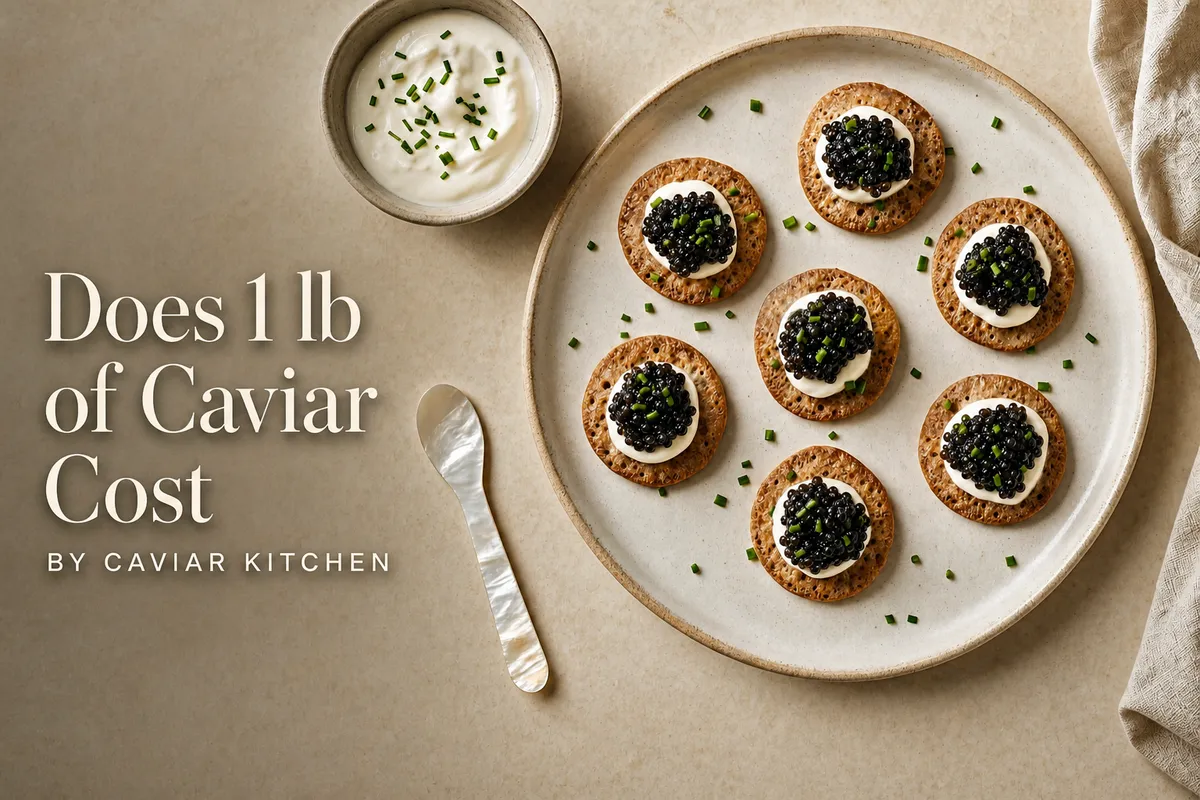
How Much Does 1 lb of Caviar Cost?
The cost of 1 lb of caviar depends almost entirely on species — Baerii (5–7 years to harvest) sits at the accessible end of the farmed market, while Huso Dauricus (10–15 years) sits at the premium end — with cold-chain logistics, grain grading, and CITES import compliance stacking on top of every species. A pound (454 g) is a wholesale-scale quantity, and those cost drivers compound hard at that volume. For current figures on every size we carry, our caviar guide breaks down what you actually get at each weight.
Why Does Caviar Cost What It Does at 1 lb?
Three factors compound to make a pound of farmed sturgeon caviar expensive regardless of which species you choose: the years a sturgeon needs to reach harvest maturity, the labour intensity of hand-grading each egg batch, and the cold-chain cost of moving a perishable product from a Sichuan mountain farm to a Toronto door in perfect condition. Baerii reaches harvest in 5–7 years. Huso Dauricus takes 10–15. That timeline difference is priced into every gram at the 454 g scale.
- Species maturity window: 5–15 years depending on the sturgeon
- Hand-harvesting: each fish assessed individually — no mechanised extraction
- Grading by grain size: larger, more uniform eggs command a significant premium
- Salt concentration: malossol (under 5% salt) preserves flavour but shortens shelf life
- Cold-chain certification: EU and US export standards require continuous temperature control
- CITES traceability: every sturgeon shipment needs species-level documentation
- Vacuum-sealed tins: not jars — oxygen contact degrades quality within hours
Honestly, species is the single biggest variable. A pound of Baerii and a pound of Kaluga Hybrid are not the same product — the flavour profiles differ, grain sizes differ, and the years invested in producing them differ by nearly a decade. See how we think about traceable sourcing and why species naming matters at every size.
How Does 1 lb Compare Across Caviar Species?
Comparing species side-by-side is the most useful frame for a pound-scale purchase, because the cost driver is not the weight — it is what is inside the tin. Each species delivers a genuinely different eating experience, and the right choice depends on who you are feeding and how you plan to serve it. Our guide to eating caviar covers the serving contexts that suit each species best.
| Species | Grain size | Flavour profile | Maturity (years) | Best suited for |
|---|---|---|---|---|
| Baerii (Siberian) | Small–medium (2–2.5 mm) | Light, clean, delicate — pure brine finish | 5–7 | First-timers, high-volume entertaining, everyday use |
| Ossetra | Medium (2.5–3 mm) | Nutty, briny, firm pop — complex mid-palate | 8–10 | Confident home cooks, dinner parties, champagne pairings |
| Kaluga Hybrid | Large (3–3.5 mm) | Buttery, sweet, soft pop — long finish | 8–12 | Hosts who want a centrepiece tin, gift buyers |
| Schrenckii (Amur) | Medium–large (2.8–3.2 mm) | Earthy, rich, savoury — bold and persistent | 9–12 | Experienced eaters, umami-forward pairings |
| Huso Dauricus | Large (3–4 mm) | Creamy, mild, almost sweet — closest to wild Beluga character | 10–15 | Special occasions, guests who know caviar well |
For a pound-scale order, most hosts land on Baerii for volume — you get more servings per gram at the accessible end of the market — or Kaluga Hybrid when the tin itself is the statement. Browse the full species breakdown before committing to 454 g of any one variety.
How Much Caviar Do You Actually Need? Portion Math for 1 lb
A pound of caviar (454 g) covers between 15 and 90 people depending on serving format — the range is that wide, which is why running the portion math before you order matters. Most buyers who ask about pound quantities are either hosting a large event or buying for resale-adjacent gifting. Getting the headcount wrong at this scale is an expensive mistake.
- Tasting portion (5–10 g per person): serves 45–90 people from 1 lb
- Appetiser portion (~15 g per person): serves roughly 30 people from 1 lb
- Centrepiece portion (~28–30 g per person): serves roughly 15 people from 1 lb
- Blini topping (~5 g per blini): covers approximately 90 blinis from 1 lb
- Pasta finish (10–15 g per bowl): serves 30–45 bowls from 1 lb
Storage matters at this scale. An unopened tin keeps for 4–6 weeks in the coldest part of your fridge — ideally 0–2 °C. Once opened, you have 24–48 hours for fresh malossol, or 3–5 days for pasteurised. A pound tin you are not serving in one sitting should stay sealed until the moment you need it. Full storage and serving instructions are here — worth reading before you open anything at this size.
What Drives the Cost of the Most Expensive Caviar?
The most expensive caviar in the legal farmed market today is Huso Dauricus at top grade — a close relative of wild Beluga (Huso huso), which is commercially banned in most markets including Canada because the species is critically endangered. At the 1 lb scale, the premium for Huso Dauricus or top-grade Kaluga Hybrid compounds fast: you are paying for 10–15 years of farm investment per fish, not just the tin and the cold-chain.
Here is the thing — grade within a species matters as much as species itself. The same Kaluga Hybrid farm produces eggs graded by colour uniformity, grain diameter, and membrane firmness. Top-grade eggs from a single sturgeon cohort command a meaningful premium over standard-grade from the same fish. We sell under actual species names rather than invented luxury tiers like "Royal" or "Imperial" — the species name tells you more. Our caviar guide explains grading in plain terms so you can compare without the ceremony.
Buying Caviar in Canada: What Changes at the 1 lb Scale?
Buying a pound of caviar in Canada adds 3 layers of cost that buyers ordering from US DTC brands do not always anticipate: CITES import documentation for each sturgeon species, Canadian Food Inspection Agency compliance, and cold-chain logistics across genuinely vast delivery distances. A GTA-based seller absorbs the last-mile cold-chain cost into local delivery — which is a real structural advantage over cross-border ordering on a perishable product.
A question we get weekly from Toronto buyers: is it cheaper to order from the US? Rarely. By the time you add international shipping on a cold product, brokerage fees, and the risk of a customs hold on a perishable item, local sourcing almost always wins on total cost and certainty. We deliver cold across the GTA, or you can collect in Yorkville. More on how we handle the cold chain from Sichuan to your door.
Before You Order a Full Pound: What to Know
A pound is a commitment. Most first-time buyers start with a 30 g or 50 g tin to confirm they have the right species before scaling up — and that is genuinely the smarter approach. The biggest mistake we hear about from customers who placed a large first order was choosing by name recognition rather than flavour preference. "Ossetra" sounds prestigious; Baerii might suit your palate better. Know what you are buying before you buy 454 g of it.
- Species first: confirm you enjoy the flavour profile before buying at volume
- Serving plan: know your portion size and headcount before you open the tin
- Spoon material: metal reacts with caviar and tastes tinny — use mother-of-pearl, bone, or plastic
- Temperature at service: serve at 0–4 °C, never room temperature
- Pairing reality: vodka, champagne, and crème fraîche are classics — so are potato chips and scrambled eggs
- Skip the lemon on the caviar: acid kills the flavour — squeeze it on the accompaniment if needed
Still working out which species fits the dishes you actually cook? Our recipes section is a practical way to match species to format before you commit to a pound. The full caviar guide covers every species in detail.
FAQ: How Much Does 1 lb of Caviar Cost?
- How much is 1 pound of caviar worth?
- A pound of farmed sturgeon caviar is a wholesale-scale quantity. The cost depends primarily on species — Baerii (5–7 years to harvest) sits at the accessible end; Kaluga Hybrid and Huso Dauricus (10–15 years) sit at the premium end. Check the shop directly for current figures, as prices update in real time.
- How expensive is 1kg of caviar?
- A kilogram is roughly 2.2 lbs — a serious volume that amplifies every cost driver: species maturity, grading, cold-chain, and import compliance. Baerii gives you the most servings per gram at the accessible end; Huso Dauricus commands the highest per-gram premium. Current figures are in the shop.
- What is the price of caviar in Canada?
- Canadian caviar prices include CITES import documentation, CFIA compliance, and cold-chain logistics — costs that US-sourced alternatives do not always account for. Species range from accessible (Baerii) to premium (Huso Dauricus). GTA buyers benefit from local cold delivery, which removes cross-border shipping risk on a perishable product. Current prices are in the shop.
- How much is caviar at Costco?
- Costco occasionally stocks farmed sturgeon caviar in larger formats, typically labelled Baerii or a generic "Osetra" — species transparency varies and farm origin is rarely disclosed. Caviar Kitchen sells under honest species names with traceable Sichuan farm sourcing. Check the shop for current sizing and figures.
- Is caviar worth the money?
- For a host feeding 15–30 people, a pound of Baerii works out to roughly 15 g per person at appetiser portions — a genuinely efficient format once you run the math. The question is really whether you have the right species for your palate and a clear serving plan. Start with a 30 g tin to confirm both before committing to a pound.
Ready to see current sizing and figures for every species we carry? Start with the caviar guide to match species to your event, then head to the shop to check live availability.
Caviar Kitchen Editorial
Caviar Kitchen Editorial
Frequently asked
How much is 1 pound of caviar worth?
A pound of farmed sturgeon caviar is a wholesale-scale quantity. The cost depends primarily on species — Baerii (5–7 years to harvest) sits at the accessible end; Kaluga Hybrid and Huso Dauricus (10–15 years) sit at the premium end. Check the shop directly for current figures, as prices update in real time.
How expensive is 1kg of caviar?
A kilogram is roughly 2.2 lbs — a serious volume that amplifies every cost driver: species maturity, grading, cold-chain, and import compliance. Baerii gives you the most servings per gram at the accessible end; Huso Dauricus commands the highest per-gram premium. Current figures are in the shop.
What is the price of caviar in Canada?
Canadian caviar prices include CITES import documentation, CFIA compliance, and cold-chain logistics — costs that US-sourced alternatives do not always account for. Species range from accessible (Baerii) to premium (Huso Dauricus). GTA buyers benefit from local cold delivery, which removes cross-border shipping risk on a perishable product. Current prices are in the shop.
How much is caviar at Costco?
Costco occasionally stocks farmed sturgeon caviar in larger formats, typically labelled Baerii or a generic "Osetra" — species transparency varies and farm origin is rarely disclosed. Caviar Kitchen sells under honest species names with traceable Sichuan farm sourcing. Check the shop for current sizing and figures.
Is caviar worth the money?
For a host feeding 15–30 people, a pound of Baerii works out to roughly 15 g per person at appetiser portions — a genuinely efficient format once you run the math. The question is really whether you have the right species for your palate and a clear serving plan. Start with a 30 g tin to confirm both before committing to a pound.