
how-to
What's a good caviar for beginners? | Caviar Kitchen
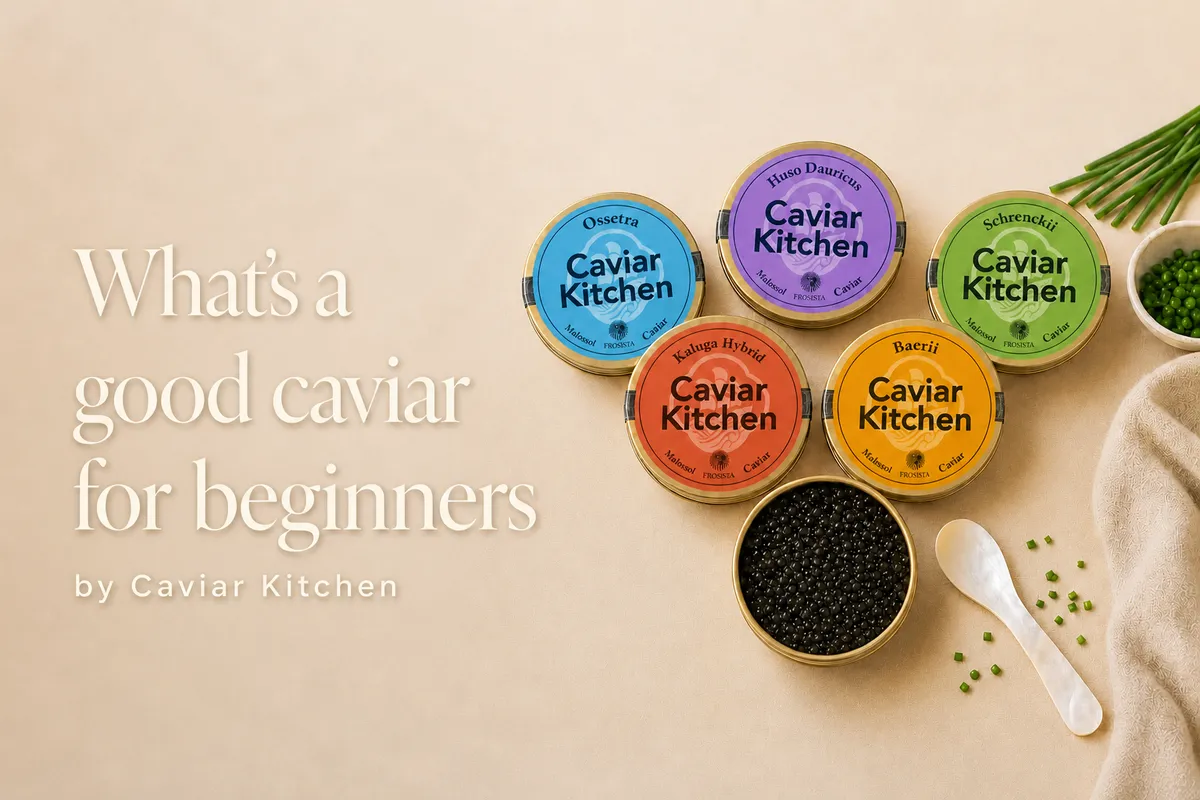
What's a good caviar for beginners?
Baerii is the best caviar for beginners — and if you're asking "What's a good caviar for beginners?", that answer holds across nearly every first-timer situation we see. Its grain runs 2–2.5 mm, its flavour is clean and lightly salty, and a 15–30 g tasting portion gives a first-timer 3 to 5 distinct tastes without overwhelming the palate. If you want one step up in complexity, Kaluga Hybrid is the second pick: larger grain at 3–3.5 mm, buttery finish, unmistakably sturgeon without being sharp or briny.
Which species should a beginner actually start with?
Most beginner guides point to Ossetra as the entry point, but that recommendation skips a step. Ossetra's nutty, briny edge — the very thing experienced buyers love — reads as "too much" for someone who has never tasted sturgeon roe before. Baerii, farmed from Siberian sturgeon, produces a smaller grain with a softer, cleaner flavour that lets the texture do the talking. Start there, and Ossetra becomes a natural second tin rather than a confusing first experience.
| Species | Grain size | Flavour profile | Best for |
|---|---|---|---|
| Baerii | Small (2–2.5 mm) | Clean, lightly salty, delicate | First tasting; pairing with neutral bases |
| Kaluga Hybrid | Large (3–3.5 mm) | Buttery, sweet, long finish | Beginners who want impact; scrambled eggs, chips |
| Ossetra | Medium (2.5–3 mm) | Nutty, briny, firm pop | Second or third tin; confident palates |
| Schrenckii | Medium-large | Rich, earthy, complex | Buyers stepping toward the Beluga family |
| Huso Dauricus | Very large (3.5 mm+) | Creamy, mild, almost sweet | Special occasion after you know your palate |
All 5 species we carry are farmed sturgeon — never wild-caught — sourced from facilities in south-west China, centred on Sichuan, certified for EU and US export. You can read more about how that sourcing works on our sturgeon sourcing page.
What makes a good caviar for a first tasting?
3 factors determine whether a first caviar experience lands well or puts someone off for years. Grain size controls how much flavour releases at once — a smaller bead is gentler. Salinity level, set during curing, ranges from malossol (lightly salted, typically under 5% salt by weight) to pressed, which is far more intense. And the serving base matters as much as the tin itself.
- Choose malossol-cured roe — salt amplifies every other flavour note
- Serve on something neutral — blini, plain potato chip, or a small spoon alone
- Use a non-metal spoon — bone, mother-of-pearl, or plastic; metal reads tinny against delicate roe
- Keep it cold — serve between 0°C and 4°C; warm caviar loses texture fast
- Start with 15 g — enough for 3–5 tastes without committing to a full serving
- Resist the urge to chew immediately — let the bead sit on the tongue for 2–3 seconds first
Our guide to eating caviar for the first time covers the full technique, including what to drink alongside it — dry Champagne or a clean vodka both work; avoid tannic reds.
How much caviar should a beginner buy?
Portion math is the question we hear most from first-timers, and the answer is simpler than the industry makes it sound. A 30 g tin gives 2 people a proper tasting. A 50 g tin covers a small appetizer for 3 to 4 people. You do not need 100 g for a first experience — that quantity is for people who already know they love it.
- Solo tasting (first time): 15–30 g total
- Two people exploring together: 30–50 g
- Small dinner party appetizer (4–6 guests): 50–100 g
- Centrepiece serving (4 guests): 120 g — roughly 30 g per person
- Gift tin (any experience level): 50 g is the most common choice
Once opened, a tin stays good for 24–48 hours in the coldest part of the fridge. Pasteurized formats hold for 3–5 days after opening. Either way, press a piece of plastic wrap directly against the surface before closing the lid — air is the enemy.
If you want the full portion breakdown with serving scenarios, our complete caviar guide has the math laid out by occasion type.
What should a beginner eat caviar with?
Here's the thing: the ceremony around caviar — the blini, the crème fraîche, the mother-of-pearl spoon — exists for good reasons, but none of it is mandatory for a first tasting. The actual goal is a neutral base that carries the roe without competing with it.
- Plain potato chips — the best first-timer vehicle; salt and fat amplify the bead
- Buttered blini — classic for a reason; the slight tang of buckwheat works well with Baerii
- Scrambled eggs — spoon caviar on at the table, never into the pan
- Deviled eggs — a quarter teaspoon on each half is enough
- Plain toast points — neutral, reliable, no competition
Avoid anything acidic or heavily seasoned for a first taste — lemon juice, vinegar-dressed salads, or strong cheeses will flatten the roe's flavour entirely. Our caviar recipes section has weeknight-friendly ideas once you have done the first plain tasting.
Contextual things to know before you order
A few caveats that most beginner guides skip over — and at least one that trips up buyers who have done some research already.
"Caviar" means sturgeon roe only. Salmon roe (ikura), trout roe, and lumpfish roe are all different products — larger, brighter in colour, and sharper in flavour. Not bad, but a different experience. If you have only tried salmon roe at a sushi restaurant, sturgeon caviar will surprise you: smaller grain, more complex, and far less aggressively salty.
Wild sturgeon is a protected species. Everything you will find from reputable sellers — including everything we carry — is farmed. That is not a compromise; modern sturgeon aquaculture produces consistent, traceable roe that wild fisheries never could. Our farms in south-west China have been operating since 2006, and the sourcing details are on our sourcing page if you want to read further.
Vague labelling is a red flag. Tins that say only "black caviar" or "premium sturgeon" without naming the species are hiding something — usually a lower-grade product or an unclear supply chain. Honest species naming (Baerii, Kaluga Hybrid, Ossetra, Schrenckii, Huso Dauricus) is the minimum standard. Our species guide explains what each name means in plain language.
Cold chain matters more than most buyers realise. Caviar shipped without adequate refrigeration — or left on a doorstep in summer — degrades fast. If you are in Toronto or the GTA, local cold-chain delivery or Yorkville pickup removes that variable entirely. Ordering from a US brand and waiting several days on standard shipping is a genuine quality risk on a first order, and one that is easy to avoid.
One more thing: do not overthink the occasion. A Tuesday with good chips is a perfectly valid reason to open a tin. The everyday approach to eating caviar is the whole point of this brand.
Frequently asked questions about caviar for beginners
- What is the best caviar to try first?
- Baerii is the most beginner-friendly sturgeon caviar — small 2–2.5 mm grain, clean flavour, lightly salty, and forgiving on a first palate. Kaluga Hybrid is the second pick if you want a larger bead and a buttery, sweeter finish. Both are far gentler entry points than Ossetra, which can read as too intense for a first taste.
- How should I try caviar for the first time?
- Serve 15 g cold (0–4°C) on a neutral base — a plain potato chip or buttered blini. Use a non-metal spoon. Let the bead sit on your tongue for 2–3 seconds before pressing it to the roof of your mouth. Avoid lemon, vinegar, or strong cheese alongside it. That is the full protocol.
- What is a good inexpensive caviar?
- Baerii is typically the most accessible entry point in the sturgeon caviar category — smaller tin sizes keep the commitment low, and the clean flavour profile means you will not feel like you wasted the purchase. Check the shop for current sizing and availability; we carry multiple tin sizes specifically for first-time buyers.
- Which caviar is the least fishy tasting?
- Baerii and Kaluga Hybrid are the least "fishy" of the sturgeon species — both read as buttery and saline rather than sharp or oceanic. Huso Dauricus is also very mild, almost sweet. The species to approach last as a beginner is Ossetra, which has the most pronounced briny, nutty edge of the common farmed varieties.
- (common question we hear) How do I store caviar after opening the tin?
- Press plastic wrap directly against the roe surface, close the lid, and keep it in the coldest part of your fridge — ideally 0–2°C. Fresh caviar holds 24–48 hours after opening; pasteurized holds 3–5 days. Never freeze an opened tin — it destroys the texture of the bead entirely.
Browse the full species range and current tin sizes in the Caviar Kitchen shop — or collect your first tin from our Yorkville pickup if you are in Toronto and want it the same day.
Caviar Kitchen Editorial
Caviar Kitchen Editorial
Frequently asked
What is the best caviar to try first?
Baerii is the most beginner-friendly sturgeon caviar — small 2–2.5 mm grain, clean flavour, lightly salty, and forgiving on a first palate. Kaluga Hybrid is the second pick if you want a larger bead and a buttery, sweeter finish. Both are far gentler entry points than Ossetra, which can read as too intense for a first taste.
How should I try caviar for the first time?
Serve 15 g cold (0–4°C) on a neutral base — a plain potato chip or buttered blini. Use a non-metal spoon. Let the bead sit on your tongue for 2–3 seconds before pressing it to the roof of your mouth. Avoid lemon, vinegar, or strong cheese alongside it. That is the full protocol.
What is a good inexpensive caviar?
Baerii is typically the most accessible entry point in the sturgeon caviar category — smaller tin sizes keep the commitment low, and the clean flavour profile means you will not feel like you wasted the purchase. Check the shop for current sizing and availability; we carry multiple tin sizes specifically for first-time buyers.
Which caviar is the least fishy tasting?
Baerii and Kaluga Hybrid are the least "fishy" of the sturgeon species — both read as buttery and saline rather than sharp or oceanic. Huso Dauricus is also very mild, almost sweet. The species to approach last as a beginner is Ossetra, which has the most pronounced briny, nutty edge of the common farmed varieties.
(common question we hear) How do I store caviar after opening the tin?
Press plastic wrap directly against the roe surface, close the lid, and keep it in the coldest part of your fridge — ideally 0–2°C. Fresh caviar holds 24–48 hours after opening; pasteurized holds 3–5 days. Never freeze an opened tin — it destroys the texture of the bead entirely.