
culture
Where Can I Buy Caviar in Toronto — Your Complete Local Guide
Where Can I Buy Caviar in Toronto — Your Complete Local Guide
Where can I buy caviar in Toronto is a question we get almost every week, and the honest answer is: more places than you'd expect, but fewer good ones than the city deserves. Toronto has grown into a genuinely interesting food city, yet the caviar retail landscape still has a gap between "whatever's at the grocery store" and "I need to really know what I'm doing to find the right tin." This guide closes that gap — every realistic channel, what each one is actually good for, and the one quality signal that separates a useful purchase from a vague one.
The short version: grocery stores offer convenience but thin species selection. Specialty retailers like Eataly carry more, but their range rotates. Direct-to-consumer brands — including us at Caviar Kitchen — offer the widest consistent selection, honest labelling, and cold-chain delivery across the GTA. Which route is right depends on what you actually need.
The Three Channels: What Each One Is Actually Good For
Toronto buyers have three distinct routes to caviar, and each one suits a different situation. Grocery stores cover convenience. Specialty retail adds curation. Direct-to-consumer adds species depth, sourcing transparency, and a cold chain you can actually trust — which matters more than most buyers realise until they've had a tin arrive warm.
Grocery stores — higher-end independents, some Loblaws locations, Whole Foods on Avenue Road — typically stock one or two caviar products. Usually a pasteurized salmon roe or a mid-range sturgeon option. That works fine if you need something fast and aren't particular about species. The trade-off is labelling. You'll see "black caviar" or a country of origin where a species name should be. If you're buying for a dinner party and want to tell your guests what they're eating, that ambiguity gets awkward fast.
Eataly Toronto at the Manulife Centre carries a more interesting selection, and their floor staff can usually walk you through what's in stock. The limitation is consistency — their caviar range rotates, so the specific tin you're after may or may not be there on a given day. Worth a visit if you're already in the Bloor-Yorkville neighbourhood. Less reliable as a dedicated caviar run.
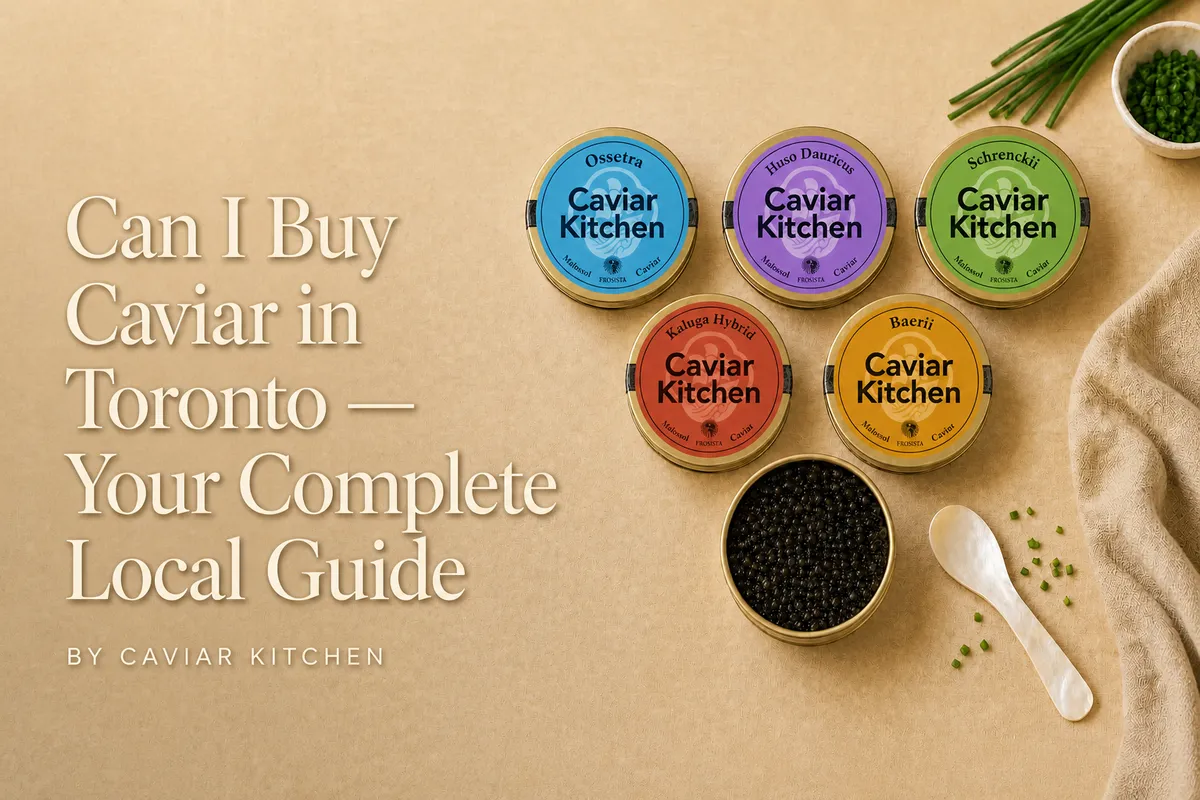
For a consistently broad species selection with honest labelling, our full caviar guide explains exactly what you're getting with each species name — Kaluga Hybrid, Ossetra, Baerii, Schrenckii, Huso Dauricus — so you can make the call before you buy, not after you open the tin.
What Does "Good Caviar" Actually Mean When You're Shopping in Toronto?
The single most useful quality signal when buying caviar in Toronto is whether the label names the sturgeon species. A tin that says "Kaluga Hybrid" or "Ossetra" is telling you something real. A tin that says "premium black caviar" or lists only a country of origin is telling you almost nothing about what's inside — and that distinction matters for texture, flavour, and whether you're getting what you paid for.
Here's the thing: the caviar market has a long history of vague naming, and Toronto retail is not immune to it. "Ossetra" is sometimes used loosely to describe any medium-grain sturgeon roe, when the real distinction is the species Acipenser gueldenstaedtii or its hybrids. Kaluga Hybrid — a cross of Huso dauricus and Acipenser schrenckii — produces one of the largest, butteriest grains available from farmed sturgeon. Worth knowing before you compare tins on a shelf.
Grain size drives texture. Kaluga Hybrid grains are large, with a soft pop and a buttery, slightly sweet finish. Ossetra grains are medium, with a firmer pop and a nutty, more mineral flavour. Baerii is the most delicate — small grains, clean and light. None is objectively better; they suit different uses. How you plan to eat it should drive the species choice as much as anything else.
Farmed caviar is the only kind you should be buying. Wild sturgeon is protected under CITES, and any wild-caught product sold legally in Canada comes with a documentation trail that most retail channels don't display. Everything we sell at Caviar Kitchen is farmed — sturgeon raised in snowmelt-fed tanks at partner farms in south-west China's Sichuan region, farming since 2006, certified for EU and US export. The sourcing is traceable. We don't hide where the roe comes from, and you can read the full breakdown on our sourcing page.
- Check for a species name — "Kaluga Hybrid", "Ossetra", "Baerii" are meaningful. "Black caviar" is not.
- Look for farmed, not wild — wild sturgeon is protected; farmed is the sustainable and legal standard.
- Check the tin date — fresh caviar has a short window; pasteurized lasts longer but has a slightly different texture.
- Ask about cold chain — caviar shipped without consistent refrigeration loses quality fast. GTA delivery with insulated packaging or Yorkville pickup removes that variable entirely.
- Know your portion — roughly 28–30 g per person as a centrepiece, 15 g as an appetizer. Buy accordingly.
Why Direct-to-Consumer Delivery Has Become the Practical Default for Toronto Buyers
Most Toronto buyers who try caviar delivery once don't go back to retail. The reasons are practical, not snobbish: a consistent cold chain, a wider species range, and labelling that tells you exactly what you're opening. The cold-chain gap in particular is something competitors rarely address — a tin that sat at room temperature for two hours during a retail transfer loses measurable quality before it's even opened.
At Caviar Kitchen, we deliver cold across the GTA, or you can collect in Yorkville — same tin, same cold chain, your choice of how to get it. There's no minimum order that forces you to overbuy, and the species selection doesn't rotate based on what happened to arrive at a loading dock that week.
So what do you actually do with it once it arrives? That's where the everyday angle matters. Our recipe section covers weeknight uses — potato chips, scrambled eggs, pasta, deviled eggs — not just the classic blini-and-champagne setup. Caviar is a salty, fatty, savoury ingredient. It makes a lot of things better. The occasion framing is optional.
The practical upside of buying direct is the context alongside the tin. Our sourcing page explains where the sturgeon are raised and how the roe is processed — useful if you're buying for someone else and want to be able to answer their questions without guessing.
Where to Buy Red Caviar in Toronto — and Why It's a Different Product
Red caviar — salmon roe, called ikura in Japanese cooking — is a genuinely different product from sturgeon caviar, and it's worth being clear about that before you buy. Salmon roe is larger, brighter in colour, and has a much poppier texture. The flavour is saltier and more oceanic than sturgeon roe. It's not a cheaper substitute for black caviar; it's a different ingredient with its own uses and its own fans.
In Toronto, salmon roe is the easier find. T&T Supermarket locations across the GTA carry it regularly — usually in the refrigerated section near the sushi supplies. Korean grocery stores in North York and Scarborough often stock it too, typically in larger jars. If ikura is what you're after, those are the right stops.
True caviar, by strict definition, is sturgeon roe only. If you're looking for that — the small-grained, buttery product from farmed Kaluga Hybrid or Ossetra sturgeon — the Asian supermarket route will mostly lead you to salmon roe instead. Not a bad thing if salmon roe is what you want. But if you're after sturgeon caviar specifically, a dedicated caviar brand or a specialty retailer is the more reliable route. The caviar guide covers the species distinctions in detail if you want to go deeper.
Is one better than the other? Wrong question. They're different products. A dinner party centrepiece calls for sturgeon caviar — the flavour complexity and the grain size read differently on a spoon. A bowl of rice or a chirashi situation? Ikura is the right call. Know what you're making, then pick accordingly.
A Quick Comparison: Buying Channels in Toronto
| Channel | Species Selection | Labelling Transparency | Cold Chain Reliability | Best For |
|---|---|---|---|---|
| Grocery store (Loblaws, Whole Foods, independents) | 1–2 options, usually vague | Low — often just country of origin | Variable | Convenience, salmon roe top-ups |
| Eataly Toronto | Moderate, rotates by season | Medium — staff knowledge helps | Good in-store | Browsing, impulse purchase |
| Asian supermarkets (T&T, H-Mart) | Salmon roe primarily | Medium | Good in-store | Ikura, tobiko, everyday roe |
| Direct-to-consumer (Caviar Kitchen) | Full species range, consistent year-round | High — real species names, sourcing info | High — insulated cold delivery or Yorkville pickup | Species selection, dinner parties, gifting, weeknight use |
FAQ
- Is Costco caviar real caviar?
- Costco does carry sturgeon roe products in some markets, so yes — it can be real caviar in the strict sense. The more useful question is what species it is and how it was processed. Costco's caviar is typically pasteurized, which extends shelf life but slightly softens the texture compared to fresh. Check the label for a species name; if it only says "black caviar" or lists a country without a species, you're buying blind on quality.
- Can I buy caviar at a grocery store?
- Yes, but the selection is limited. Most Toronto grocery stores — including higher-end independents — carry one or two caviar products, often pasteurized and labelled vaguely. You're more likely to find salmon roe (ikura) than sturgeon caviar. If you want a specific species like Kaluga Hybrid or Ossetra, a specialty retailer or a direct-to-consumer brand is a more reliable option than a standard grocery run.
- Where can I buy Canadian caviar?
- There are a small number of Canadian sturgeon farms — primarily in British Columbia and Quebec — producing domestic caviar. Specialty food retailers and some online sellers carry these. At Caviar Kitchen, our caviar is farmed in south-west China's Sichuan region, not in Canada. We're a Toronto-based business, but our sourcing is from partner farms abroad. We're transparent about that distinction because provenance is a factual claim about food, and it matters.
- What is the best caviar for beginners?
- Kaluga Hybrid is the most approachable starting point for most buyers. The grains are large, the flavour is buttery and mildly sweet, and the texture — a soft pop rather than a firm one — is less polarising than the more mineral Ossetra. A 30 g tin is enough for a proper first tasting. Start with a plain cracker or a small potato chip so the caviar flavour isn't competing with anything. You can read the full species breakdown in our caviar guide.
- How do I store caviar after opening?
- Once opened, fresh caviar should be kept in the coldest part of your fridge — typically the back of the bottom shelf — and eaten within 24–48 hours. Pasteurized caviar holds for 3–5 days after opening under the same conditions. Press a piece of plastic wrap directly against the surface before closing the tin to limit air contact. Do not freeze it — freezing ruptures the grains and destroys the texture entirely.
Ready to skip the guesswork? Browse the full species range at Caviar Kitchen — delivered cold across the GTA, or collected at our Yorkville pickup point. If you're not sure which species to start with, the caviar guide walks through every option in plain language, and the how-to section covers everything from spoon choice to portion size so your first tin goes exactly the way it should.
Caviar Kitchen Editorial
Caviar Kitchen Editorial
Frequently asked
Is Costco caviar real caviar?
Costco does carry sturgeon roe products in some markets, so yes — it can be real caviar in the strict sense. The more useful question is what species it is and how it was processed. Costco's caviar is typically pasteurized, which extends shelf life but slightly softens the texture compared to fresh. Check the label for a species name; if it only says "black caviar" or lists a country without a species, you're buying blind on quality.
Can I buy caviar at a grocery store?
Yes, but the selection is limited. Most Toronto grocery stores — including higher-end independents — carry one or two caviar products, often pasteurized and labelled vaguely. You're more likely to find salmon roe (ikura) than sturgeon caviar. If you want a specific species like Kaluga Hybrid or Ossetra, a specialty retailer or a direct-to-consumer brand is a more reliable option than a standard grocery run.
Where can I buy Canadian caviar?
There are a small number of Canadian sturgeon farms — primarily in British Columbia and Quebec — producing domestic caviar. Specialty food retailers and some online sellers carry these. At Caviar Kitchen, our caviar is farmed in south-west China's Sichuan region, not in Canada. We're a Toronto-based business, but our sourcing is from partner farms abroad. We're transparent about that distinction because provenance is a factual claim about food, and it matters.
What is the best caviar for beginners?
Kaluga Hybrid is the most approachable starting point for most buyers. The grains are large, the flavour is buttery and mildly sweet, and the texture — a soft pop rather than a firm one — is less polarising than the more mineral Ossetra. A 30 g tin is enough for a proper first tasting. Start with a plain cracker or a small potato chip so the caviar flavour isn't competing with anything. You can read the full species breakdown in our caviar guide.
How do I store caviar after opening?
Once opened, fresh caviar should be kept in the coldest part of your fridge — typically the back of the bottom shelf — and eaten within 24–48 hours. Pasteurized caviar holds for 3–5 days after opening under the same conditions. Press a piece of plastic wrap directly against the surface before closing the tin to limit air contact. Do not freeze it — freezing ruptures the grains and destroys the texture entirely.